You know what drives me absolutely bonkers? Walking into a gas station, seeing a tiny bag of jerky that looks like it has maybe three pieces of meat in it, and realizing it costs as much as a movie ticket. I remember standing in line once, hungry after a long road trip, and actually putting the bag back because I just couldn’t justify spending $12 on two ounces of dried beef. That was the moment I decided I had to figure out Homemade Teriyaki Beef Jerky Strips for myself. I’m a teacher on a budget, not a millionaire, and while my first batch was basically salty shoe leather that even my dog refused to eat, I’ve finally nailed it after years of testing. This recipe gets you that perfect sweet and tangy flavor without the crazy price tag, and honestly, if I can mix some stuff in a bowl and turn on an oven without burning the house down, you can definitely do this too.
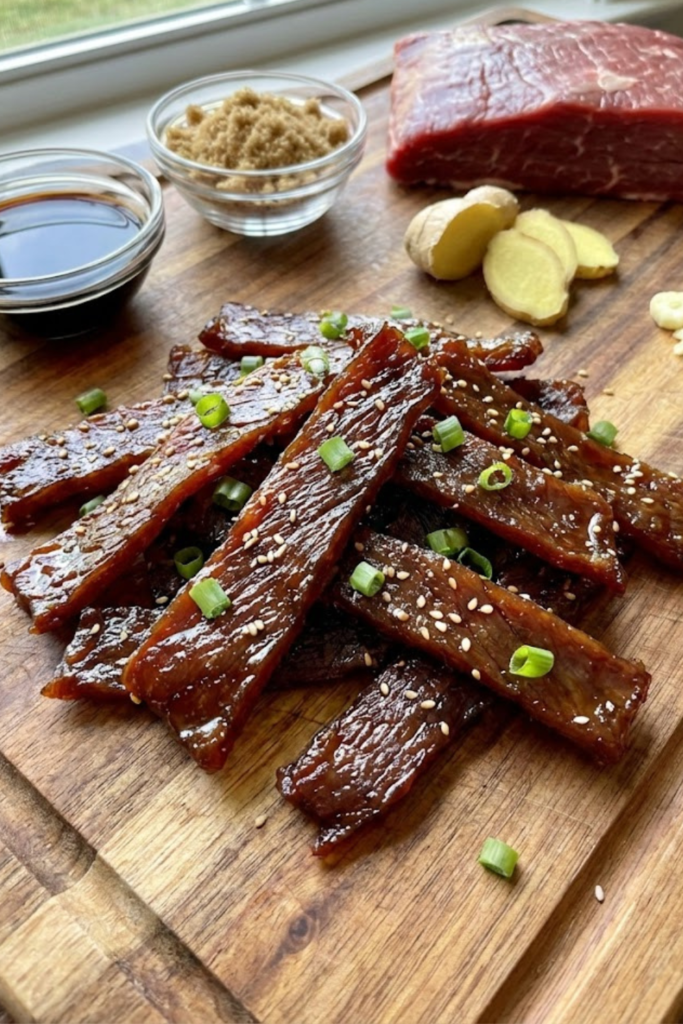
Choosing the Right Cut of Beef for Jerky
When I first started making jerky, I just grabbed whatever roast was on sale at the grocery store. Big mistake. I didn’t realize that fat is basically the enemy of good jerky. While we love marbling in a juicy steak for dinner, fat doesn’t dry out the same way muscle does. It just sits there and eventually goes rancid, which ruins all your hard work. So, you gotta look for the leanest beef you can find.
My absolute favorite cut for Homemade Teriyaki Beef Jerky Strips is Eye of Round. It is usually the cheapest lean roast available, and the grain runs straight, which makes it easy to work with. If you can’t find that, Top Round is a solid backup. I’ve used Flank Steak before, and while it tastes amazing, it’s usually way more expensive, and I’m trying to save money here!
Here is a trick that saved me so much time: ask the butcher to slice it for you! Seriously, just walk up to the meat counter and ask them to slice the roast about 1/4 inch thick. They have those big fancy slicers that get it perfectly even in seconds. It saves you from fighting with a slippery piece of meat on your kitchen counter for an hour. If you do end up cutting it yourself, pop the meat in the freezer for about 45 minutes first so it firms up. It makes slicing way easier.
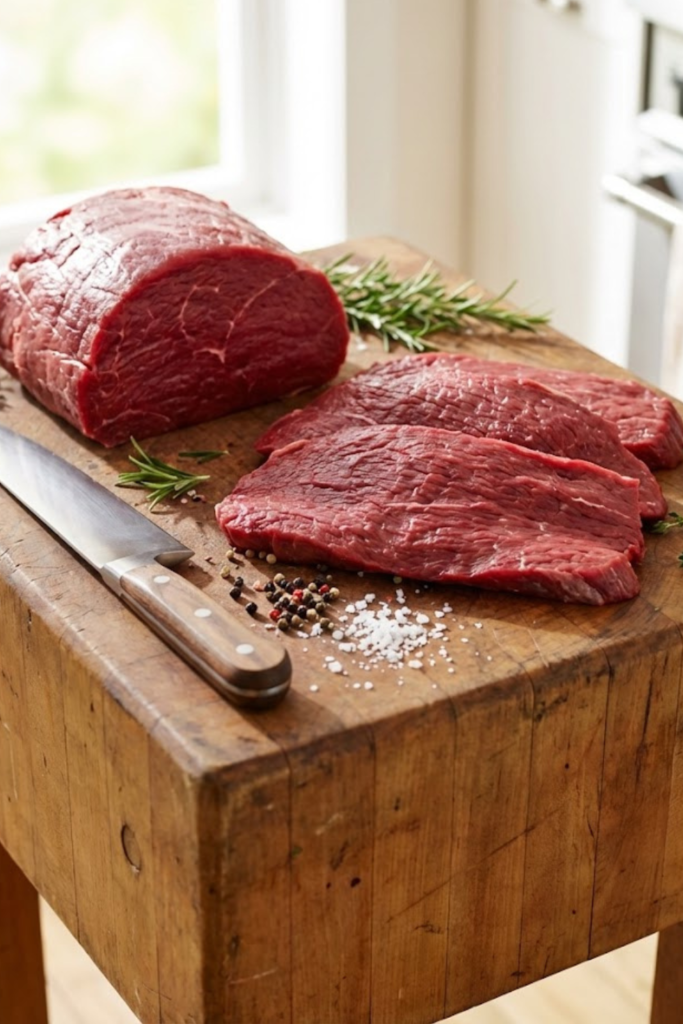
The Secret to the Perfect Teriyaki Marinade
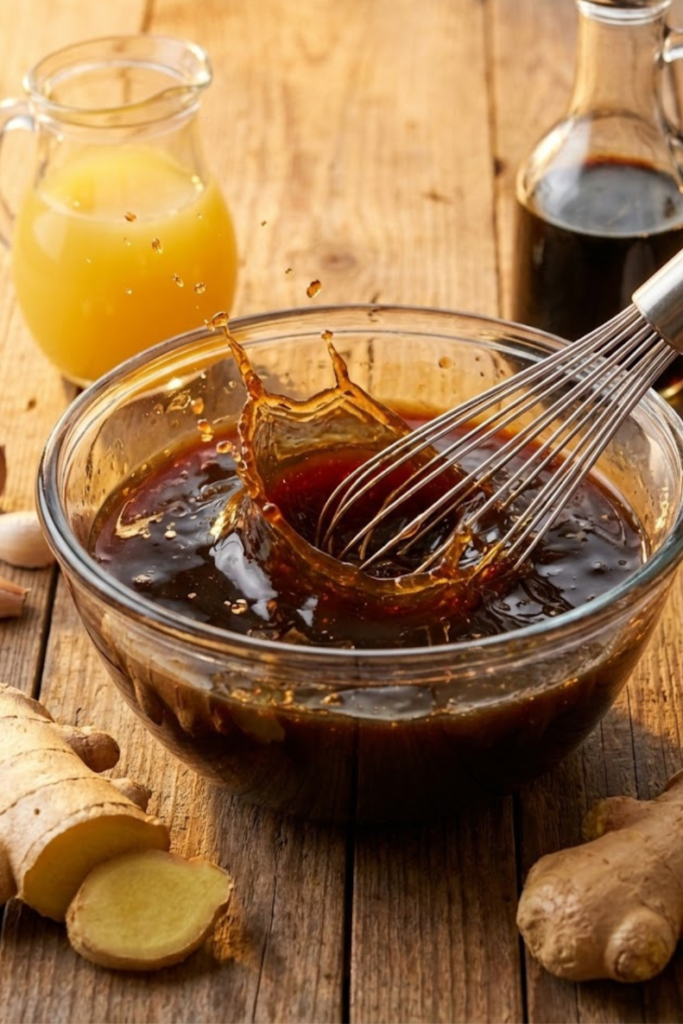
Okay, now for the fun part—making it taste good. When I first tried this, I thought I could just dump a bottle of store-bought teriyaki sauce on the meat and call it a day. It was okay, but it lacked that “wow” factor. It tasted kinda flat. I learned that making your own marinade is actually super easy and tastes a million times better.
You need a good balance of salty and sweet. I always start with a base of soy sauce, but I use the low-sodium kind. If you use regular soy sauce, the Homemade Teriyaki Beef Jerky Strips can get way too salty once the meat dries out and shrinks. To get that sticky sweetness, I mix in a good amount of brown sugar. Honey works too, but brown sugar gives it that classic dark color we all love.
Here is my secret weapon: pineapple juice. It sounds a little weird, but hear me out. Pineapple has this enzyme in it that breaks down meat fibers. Since we are using lean cuts that can be tough, a splash of pineapple juice acts like a natural tenderizer. Just don’t let it sit for like two days, or the meat gets mushy (learned that the hard way!).
Don’t forget the aromatics! I used to use garlic powder and ginger powder because it was easier, but switching to fresh minced garlic and fresh ginger root made a huge difference. It gives it a fresh kick that the powders just don’t have. Whisk it all together in a bowl until the sugar dissolves. Then, combine it with your meat in a Ziploc bag and let it hang out in the fridge. I try to leave it for at least 6 hours, but overnight is best if you can wait that long!
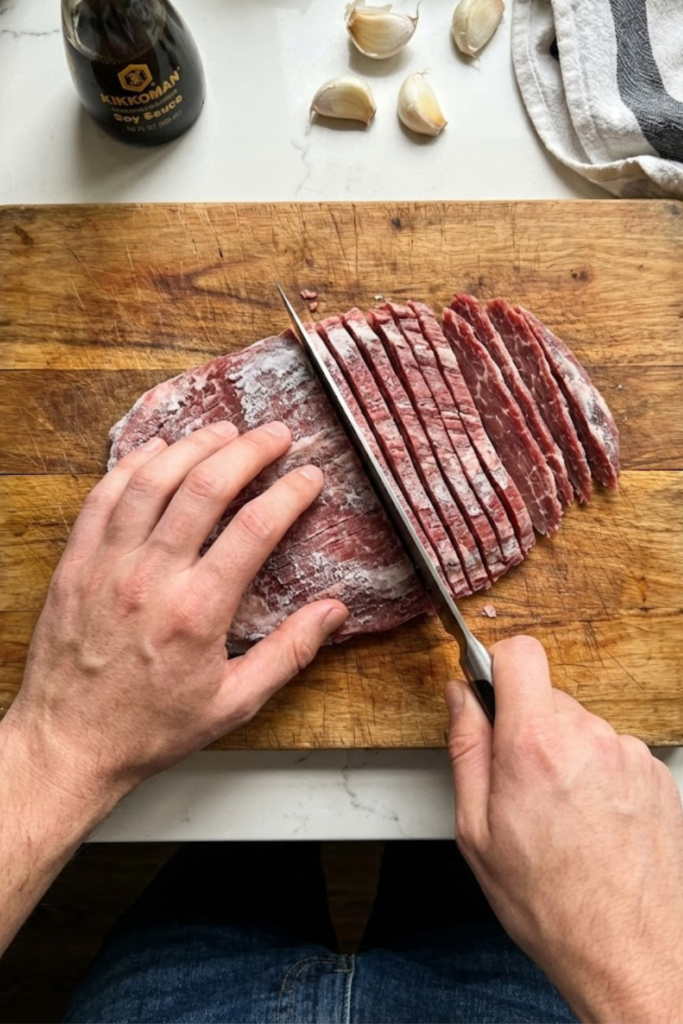
How to Slice Meat for Maximum Tenderness
I learned this the hard way: trying to slice a raw, squishy roast at room temperature is a nightmare. It slides all over the place, and you end up with weird, jagged pieces. The best trick I ever learned was to stick the meat in the freezer for about an hour or two before you start cutting. You don’t want it frozen solid like a rock, just firm enough that it holds its shape. It makes slicing so much easier and safer because the knife doesn’t slip as much.
Now, you have to look at the “grain” of the meat. You will see these little lines running through the beef fibers. This is super important for Homemade Teriyaki Beef Jerky Strips. If you cut with those lines, your jerky is going to be tough as nails. It will be chewy and really hard to eat. I prefer to cut against the grain (perpendicular to the lines). This cuts those long muscle fibers short, so when you bite into the finished jerky, it breaks apart easily. Aim for slices that are about 1/4 inch thick. If you make them too thick, they take forever to dry, and if they are too thin, they get crispy like chips. Just try to keep them all the same size so they finish drying at the same time.
Drying Methods: Dehydrator vs. Oven
I remember when I finally bought a food dehydrator. It was a cheap round one I found online, and honestly, it changed the game for me. But before that, I used my regular kitchen oven, and it worked just fine too. You don’t need fancy equipment to make Homemade Teriyaki Beef Jerky Strips, you just need a little patience.
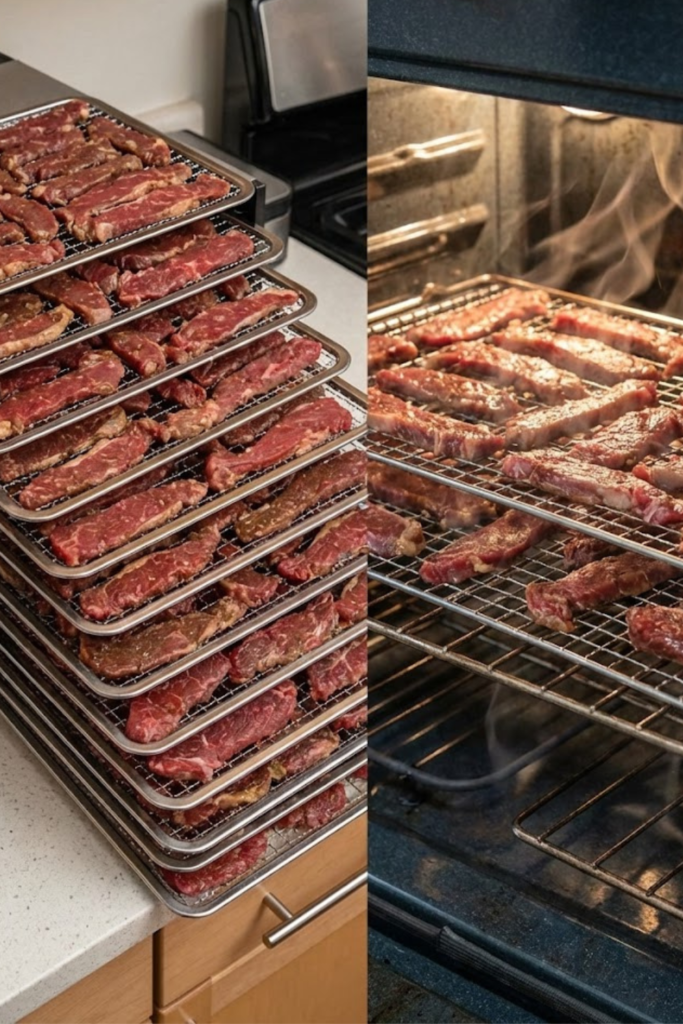
If you have a dehydrator, it is super simple. Lay the strips out on the trays so they aren’t touching. They need personal space so the air can move around them. Crank it up to 160°F (71°C). I read somewhere that this is the safe temperature to kill off any bad bacteria. I usually let it run for about 4 to 6 hours, but I start checking it around the 4-hour mark because thinner pieces dry faster.
If you are using an oven, set it to the lowest temperature it goes, usually around 170°F. Here is the trick: stick a wooden spoon in the door to keep it cracked open just a tiny bit. This lets the moisture escape instead of just steaming the meat. You’ll want to put the meat on wire cooling racks over a baking sheet, not directly on the foil, so air hits the bottom too.
How do you know when it’s done? I use the “Bend Test.” Take a piece out and let it cool for a minute (warm jerky feels softer than it actually is). Bend it in half. It should bend and show little white fibers in the middle, but it shouldn’t snap in half like a dry cracker. If it feels squishy, it needs more time. If it snaps, you overcooked it, but hey, it’s still edible!
Storing Your Homemade Jerky for Freshness
I have to tell you about the saddest day of my jerky-making career. I made a huge batch of Homemade Teriyaki Beef Jerky Strips, and I was so excited that I threw it all into a plastic bag while it was still a little warm. I woke up the next morning to see water droplets inside the bag and, a few days later, fuzzy green mold. It was heartbreaking to throw it all away.
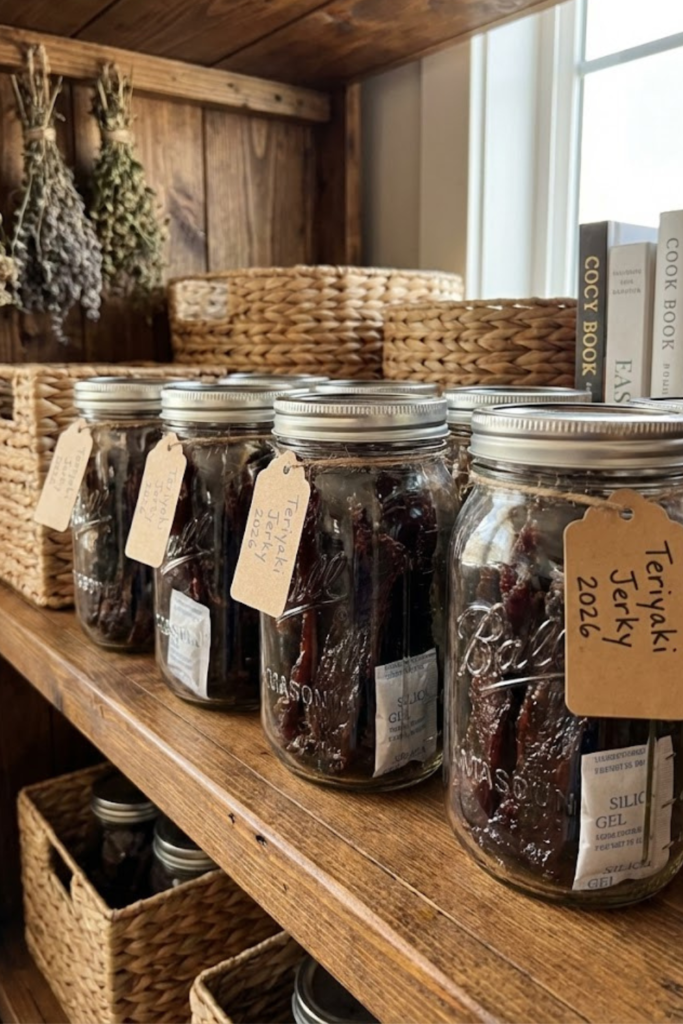
So, lesson learned: let your jerky cool down completely on the counter before you pack it away. You want it to be room temperature. For storage, I really like using glass Mason jars. They seal tight and keep the air out. If you have a vacuum sealer, that is even better, especially if you made a giant batch.
Since we aren’t using heavy-duty chemical preservatives like the factory stuff, this jerky won’t last forever on the counter. I usually keep a small bag out for snacking during the week and put the rest in the refrigerator. It stays fresh in the fridge for a few weeks, though honestly, it never lasts that long in my house because my family eats it too fast!
Making your own snacks feels pretty good, doesn’t it? It saves money, and you know exactly what ingredients went into it. No mystery meat here! I hope you give this recipe a shot. Even if your first try isn’t perfect, keep tweaking it until it’s just how you like it. It took me a few tries to get it right, but now I can’t go back to the expensive store-bought bags.
If you found this helpful and think you might want to try this later, please save this to your “Snack Ideas” or “Recipes” board on Pinterest so you don’t lose it. Happy cooking!